
Downshifting or Path Divergence? In-Depth Analysis of Lighting Exports in Q1 2026
sourcewww.lightingchina.com.cn
time2026/06/05

- According to the latest data released by the General Administration of Customs of China, China’s total exports of lighting products from January to April 2026
According to the latest data released by the General Administration of Customs of China, China’s total exports of lighting products from January to April 2026 amounted to approximately USD 15.1 billion, representing a year-on-year decline of around 8%. Lighting products accounted for 1.8% of total exports of electromechanical products during the same period.
From a monthly perspective, export performance showed significant volatility. In March, exports declined by 40% compared with the same month last year. In April, export value reached approximately USD 3.8 billion, down 16% year-on-year, with the rate of decline narrowing by 24 percentage points compared to March, indicating early signs of recovery.
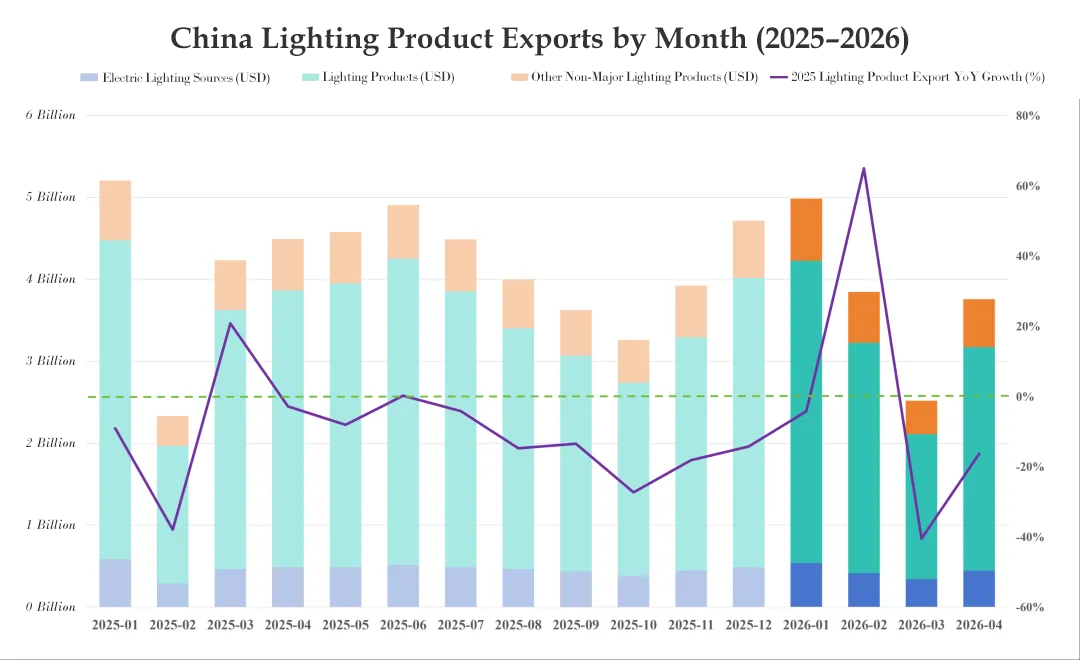
However, a surface-level interpretation based solely on total export value is insufficient to reveal the underlying structural dynamics. A closer examination of the USD 15.1 billion reveals that the slowdown has not been uniform across the board. Instead, there are pronounced disparities in market performance, increasing divergence among product categories, and clearly differentiated strategies adopted by different enterprises. The essence of export dynamics is gradually shifting from a simple question of “growth versus decline” to a more complex issue of “selection and structural repositioning.”
PART 01: U.S. Market — A Structural Setback
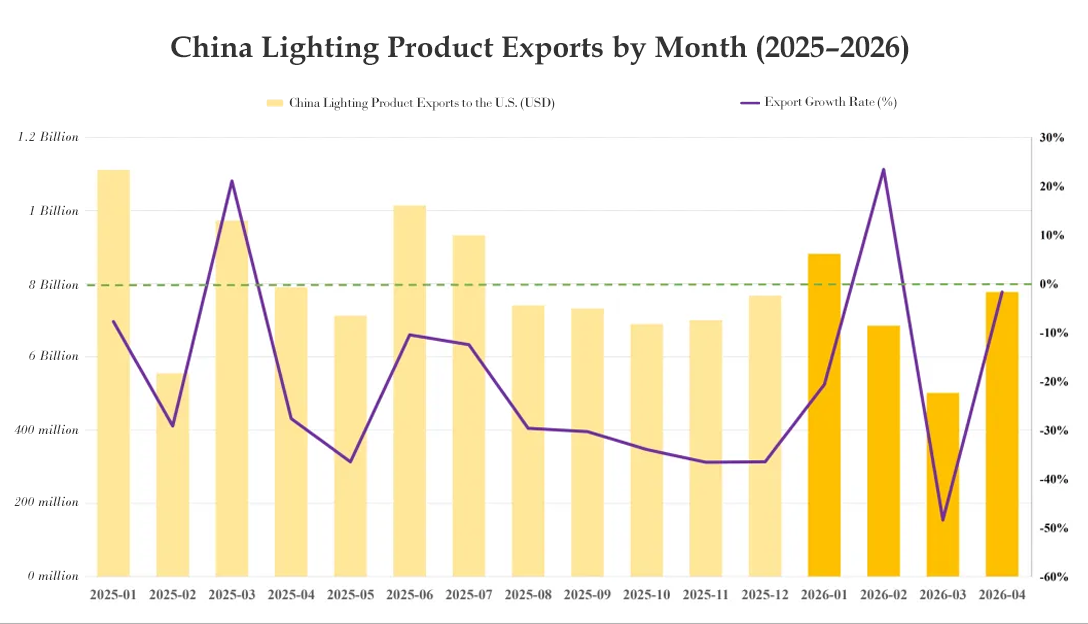
The United States remains the largest single export destination for China’s lighting products. In Q1 2026, exports to the U.S. totaled approximately USD 2.8 billion, representing a year-on-year decline of 17%. Specifically, exports of lighting fixtures fell by 21%, while electric light source products declined by 7%. In April, exports to the U.S. dropped by only 2% year-on-year, indicating a significantly narrower contraction compared with previous months.
However, short-term monthly recovery should not be mistaken for a structural reversal. A closer examination suggests that the decline in exports to the U.S. is not merely driven by cyclical economic fluctuations. In April of the previous year, the United States implemented reciprocal tariffs targeting global trade, significantly disrupting the rhythm of international commerce in Q2 2025. Entering 2026, the overall tariff burden on Chinese products remains high, with most LED-related products still facing tariff barriers of around 25%. As a result, the cost structure for Chinese lighting exports to the U.S. has fundamentally changed. This shift is structural rather than temporary, and it is likely to continue reshaping the underlying logic of China–U.S. lighting trade in the years ahead.
More importantly, this pressure is extending beyond pricing and influencing global industrial organization. A typical response has been the accelerated relocation of production capacity overseas. For example, Leedarson Lighting has already put Phase I of its Thailand manufacturing base into operation, with Phase II scheduled for completion in 2027, primarily serving U.S. market demand. Meanwhile, Foshan Electrical and Lighting Co., Ltd. is also accelerating the construction of its Thailand factory, upgrading production lines and ramping up capacity, with the facility positioned as a key hub for mitigating international trade friction.
These developments indicate that leading enterprises have already reached a strategic conclusion: the traditional export route directly from mainland China to the U.S. is becoming increasingly constrained. As a result, the regionalization of global supply chains is emerging as a long-term structural trend.
PART 02: Europe and Africa — Two Engines, Two Logics
Against the backdrop of overall export slowdown, two regional markets—Europe and Africa—have demonstrated counter-trend growth, yet their underlying growth mechanisms differ significantly.
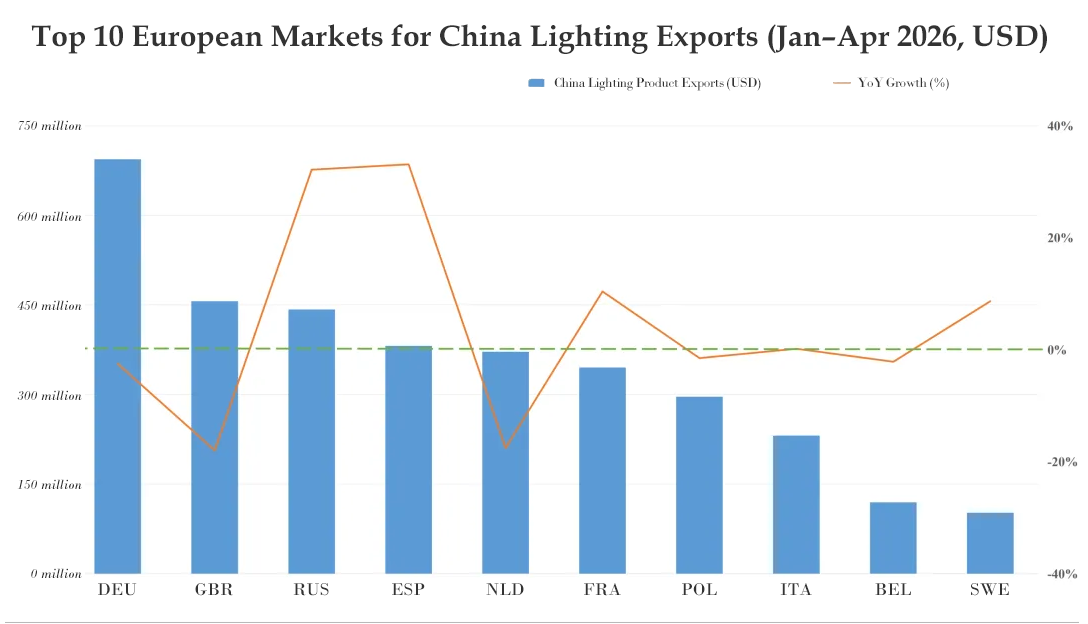
From January to April 2026, China’s lighting product exports to Europe reached approximately USD 4 billion, representing a year-on-year increase of around 1% and accounting for roughly 27% of total exports, up by 2 percentage points compared with the same period last year. Although a 1% increase may appear modest, a deeper breakdown reveals stronger momentum in key markets. Among the top 10 European destinations, Russia, Spain, and France recorded growth rates of 32%, 33%, and 10%, respectively.
More importantly, the overall European Union market achieved a robust 8% growth in Q1. This reflects an accelerating replacement cycle in Europe’s stock lighting market, driven by persistently high energy costs. Energy-efficient lighting upgrades are no longer viewed as an optional alternative but have effectively become a necessity. Energy-saving renovation has thus shifted from a substitute solution to an essential action across the region.
In contrast, exports to Africa reached approximately USD 1.1 billion in the first four months, up around 5% year-on-year, accounting for 7.4% of total exports and increasing by 1 percentage point compared with the previous year. Unlike Europe, Africa’s growth is primarily driven by rising new demand, as urbanization accelerates, electricity infrastructure expands, and new construction projects continue to increase across the continent.
In response, companies such as Foshan Electrical and Lighting Co., Ltd. have dispatched teams to conduct on-site market research in Africa and are formulating strategies to transition from pure trade-based exports toward more localized engagement models. This reflects leading enterprises’ long-term strategic recognition of Africa’s structural growth potential.
PART 03: Middle East — A Warning from Sudden Disruption
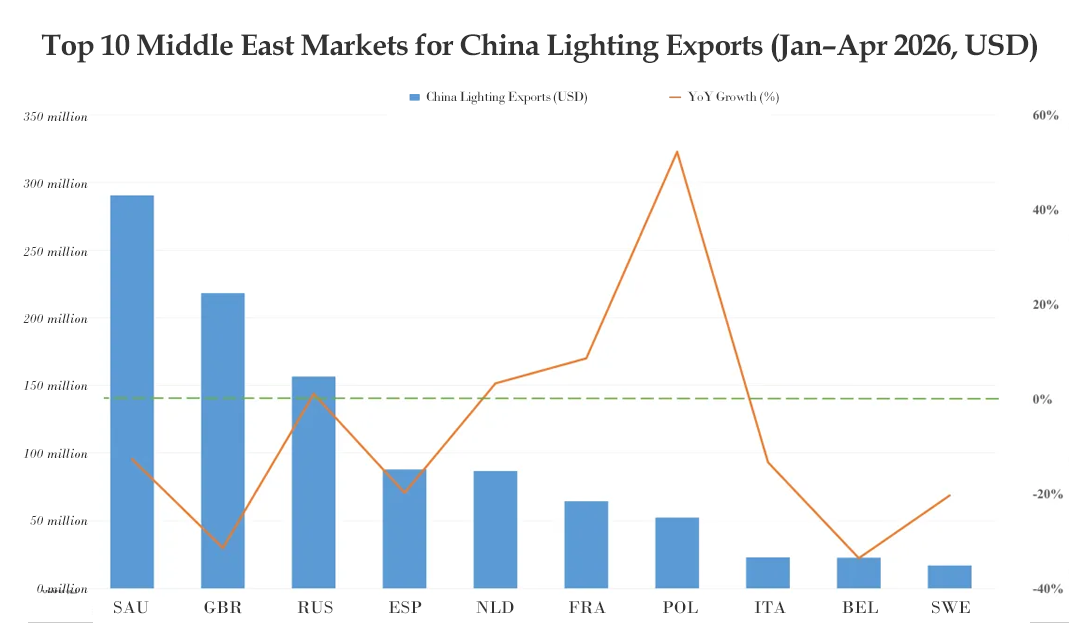
In the first four months of 2026, China’s lighting product exports to the Middle East totaled approximately USD 1.1 billion, representing a year-on-year decline of 14%. More concerning is the sharp month-by-month deterioration: in March alone, exports plunged by 70% compared with the same period last year, followed by a further 58% decline in April.
A recent survey conducted by the China Lighting Industry Association shows that in Guangdong’s manufacturing clusters, export orders fell by more than 30% year-on-year. The decline was particularly severe in non-essential product categories such as crystal chandeliers, where demand dropped significantly. In Zhejiang, some enterprises reported that direct export orders to the Middle East decreased by nearly one-third compared with the same period last year.
The primary drivers behind this downturn include escalating geopolitical tensions in the region, which have significantly increased logistics costs, disrupted delivery schedules, and undermined international buyers’ confidence.
The sudden cooling of the Middle Eastern market serves as a clear illustration of geopolitical risk in global trade. It has reinforced a fundamental but often overlooked principle across the industry: regional export strategies should not be based solely on growth potential, but must also incorporate risk exposure. In market selection, enterprises must increasingly consider the concept of a “safety margin” when making strategic decisions.
PART 04: Conclusion

Structural pressure often creates structural opportunity. From a macro perspective, the global LED lighting market is expected to enter a critical transition phase in 2026, shifting from contraction toward stabilization, with the total market size projected to reach approximately USD 82.042 billion. In Europe, the replacement cycle in the existing stock lighting market is accelerating, while incremental expansion continues to develop across North America, Asia, and the Middle East. However, these favorable trends do not benefit all enterprises equally.
China’s lighting product exports are entering a further deceleration phase. While slower growth is an undeniable reality, more important is the structural transformation behind it: a shift from linear growth driven by dependence on a single market toward a more flexible, multi-regional allocation model; and a transition from pure price-based competition to comprehensive competition across supply chain resilience, brand capability, and strategic market positioning. For companies with long-term potential, the current downturn is precisely a window of opportunity to redefine and rebuild competitive advantages.